
Impact of Home Environment on Children
Impact of Home Environment on Children: The Invisible Force Shaping Every Child
Two children grow up in the same city, attend the same school, and study the same books.
But one is confident, calm, and expressive.
The other is anxious, withdrawn, or aggressive.
What makes the difference?
Often, it is not the school. Not the curriculum. Not even intelligence.
It is the home environment.
The space where a child feels safe—or unsafe, heard—or ignored, supported—or pressured, shapes development more deeply than most parents realize.
What Is Home Environment?
Home environment refers to the emotional, social, and physical conditions in which a child grows.
It includes:
- Parent-child relationships
- Communication patterns
- Discipline style
- Emotional climate
- Daily routines
- Physical safety and stability
It is not about luxury or income. It is about experience and interaction.
WHY HOME ENVIRONMENT MATTERS
Children spend their early years primarily at home. During this time, their brain develops rapidly.
According to the World Health Organization, early environments significantly influence cognitive, emotional, and social development (WHO, 2020).
A supportive home environment promotes healthy growth. A stressful environment can hinder development.
HOW HOME ENVIRONMENT INFLUENCES DEVELOPMENT
Emotional Development
Children learn how to understand and manage emotions by observing their parents.
In a calm and supportive home:
- Children feel secure
- Emotional expression is encouraged
- Stress is reduced
In a tense or unpredictable home:
- Anxiety increases
- Emotional regulation becomes difficult
- Fear or withdrawal may develop
According to John Bowlby, early relationships with caregivers form the foundation of emotional security (Bowlby, 1969).
Cognitive Development
A stimulating home environment enhances thinking and learning.
Children exposed to conversation, reading, and interaction develop:
- Better language skills
- Stronger memory
- Improved problem-solving
Lack of stimulation may delay cognitive development.
Social Development
Children learn social behavior at home first.
Respectful communication teaches cooperation and empathy.
Conflict and aggression in the home may lead to similar behavior in children.
According to Albert Bandura, children imitate behaviors they observe in their environment (Bandura, 1977).
Behavioral Development
Consistent rules and routines create stability.
Children raised in structured environments show:
- Better discipline
- Higher responsibility
- Improved self-control
Inconsistent parenting may lead to confusion and behavioral problems.
TYPES OF HOME ENVIRONMENTS AND THEIR IMPACT
Supportive and Nurturing Environment
- Open communication
- Emotional warmth
- Consistent guidance
Impact: Confidence, emotional stability, and strong social skills.
Overly Strict Environment
- Excessive control
- Limited freedom
- Harsh discipline
Impact: Fear, low self-esteem, or rebellion.
Neglectful Environment
- Lack of attention
- Emotional distance
- Limited supervision
Impact: Behavioral issues, insecurity, and poor development.
Chaotic or Stressful Environment
- Frequent conflict
- Unpredictable routines
- Emotional instability
Impact: Anxiety, aggression, and difficulty focusing.
THE ROLE OF PARENTING STYLE
Parenting style shapes the home environment.
Balanced parenting—combining warmth with structure—produces the best outcomes.
According to Diana Baumrind, authoritative parenting (supportive but firm) is linked to positive child development (Baumrind, 1967).
HOME ENVIRONMENT AND SPECIAL NEEDS CHILDREN
Children with conditions like Autism Spectrum Disorder are even more sensitive to their environment.
They often require:
- Predictable routines
- Low sensory stress
- Structured support
A stable home environment significantly improves behavior and learning outcomes.
Signs of a Healthy Home Environment
- Children feel safe and secure
- Open communication exists
- Emotional needs are acknowledged
- Routines are consistent
- Positive behavior is reinforced
Warning Signs of a Harmful Environment
- Frequent conflict or shouting
- Emotional neglect
- Inconsistent discipline
- Lack of supervision
- High stress levels
These signs may affect a child’s long-term development.
HOW PARENTS CAN IMPROVE THE HOME ENVIRONMENT
Start with small, consistent changes.
Create routines that provide structure and predictability.
Communicate calmly and respectfully.
Spend quality time with children, even if it is brief.
Reduce unnecessary stress and conflict in the home.
Encourage emotional expression and listen actively.
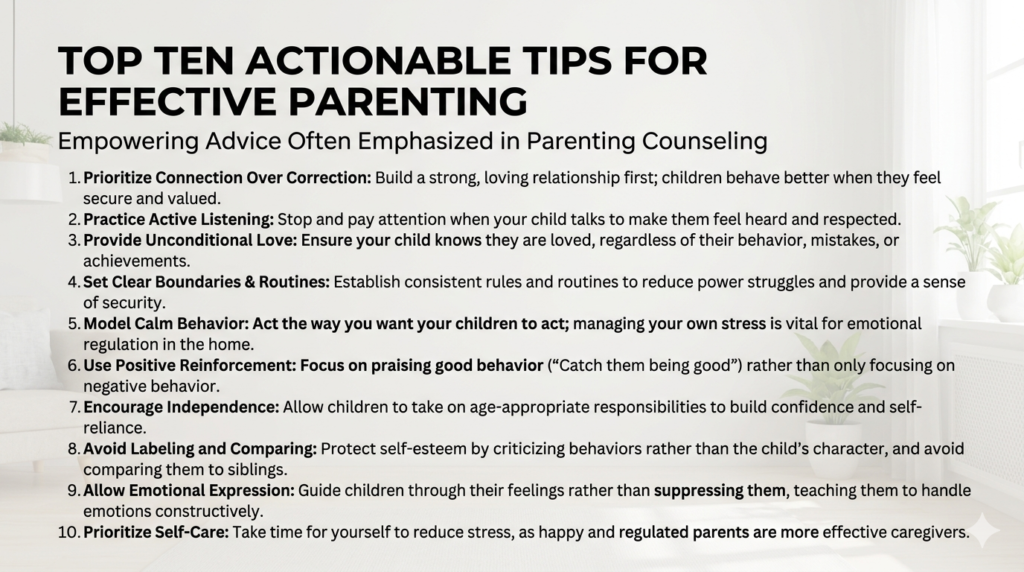
Top 10 Practical Tips for Parents
- Maintain a calm and respectful environment
- Communicate openly with your child
- Set consistent rules and boundaries
- Encourage emotional expression
- Spend quality time daily
- Reduce exposure to conflict
- Support learning at home
- Be a positive role model
- Provide a safe and stable space
- Seek help when needed
Final Thought
A home is more than walls and furniture.
It is an emotional space where a child learns how to feel, think, and behave.
You do not need a perfect home to raise a healthy child.
You need a consistent, supportive, and understanding environment.
Because the way a child experiences home becomes the way they experience the world.
REFERENCES (APA 7)
- Bowlby, J. (1969). Attachment and loss. Basic Books.
- Bandura, A. (1977). Social learning theory. Prentice Hall.
- Baumrind, D. (1967). Child care practices and developmental outcomes. Genetic Psychology Monographs.
- World Health Organization. (2020). Early childhood development guidelines.