
Social Development of Children
SOCIAL DEVELOPMENT
Social development refers to a child’s ability to:
- Interact with others
- Build relationships
- Understand social rules
- Communicate effectively
- Develop empathy and cooperation
It begins in early childhood and continues throughout life.
- Social development is an important aspect of child development. It is the ability to form positive and pleasing relationships with others (Cohen et al., 2005).
- This is important to note that social development is closely associated with emotional development and these two aspects of development are frequently termed as socioemotional development. It means that both of the developments occur simultaneously.
- Social development includes learning the values, knowledge and skills that enable children to relate to others effectively and to contribute in positive ways to family, school and the community.
- This kind of learning is delivered on to children by three means: directly by parents and teachers; indirectly through social relationships within the family or with friends, and through children’s participation in the culture around them.
- Social skills include various abilities such as communication, problem-solving, decision making, self-management, and peer relations.
- Social competence is related to peer acceptance, teacher acceptance, present success, and future (post school) success.
Why Social Development Is Important
Strong social skills help children:
- Build friendships
- Adjust to school environments
- Resolve conflicts
- Develop confidence
- Improve emotional well-being
Research shows that early social competence is strongly linked to long-term academic and psychological success (Denham et al., 2003).
How Social Development Happens
Children learn social behavior through experience and observation.
According to Albert Bandura, children learn by observing and imitating others (Bandura, 1977).
This means:
- Parents are role models
- Siblings influence behavior
- Peers shape interaction
- Environment teaches social norms
STAGES OF SOCIAL DEVELOPMENT
Infancy (0–2 Years): Attachment and Trust
Key Features
- Bonding with caregivers
- Responding to facial expressions
- Seeking comfort
According to John Bowlby, early attachment forms the basis of future relationships (Bowlby, 1969).
Parent Role
Provide consistent care and emotional security.
Early Childhood (2–6 Years): Play and Interaction
Key Features
- Parallel and cooperative play
- Learning to share
- Beginning friendships
Children start understanding basic social rules.
Parent Role
Encourage group play and guide behavior gently.
Middle Childhood (6–11 Years): Friendship and Cooperation
Key Features
- Strong peer relationships
- Teamwork and cooperation
- Understanding fairness
Social comparison and acceptance become important.
Parent Role
Support healthy friendships and teach conflict resolution.
Adolescence (12–18 Years): Identity and Social Belonging
Key Features
- Strong peer influence
- Desire for acceptance
- Social identity formation
According to Erik Erikson, this stage focuses on identity development shaped by social interaction (Erikson, 1968).
Parent Role
Respect independence while maintaining guidance.
Key Social Skills Children Develop
- Communication skills
- Empathy and understanding
- Cooperation and sharing
- Conflict resolution
- Adaptability in social settings
These skills develop gradually through experience.
FACTORS AFFECTING SOCIAL DEVELOPMENT
Family Environment
Warm and supportive families promote healthy social behavior.
School and Peers
Interaction with peers helps develop cooperation and communication.
Media and Technology
Digital exposure can influence social behavior positively or negatively.
Culture
Cultural values shape social norms and expectations.
Social Challenges in Children
Some children may experience:
- Shyness or social anxiety
- Difficulty making friends
- Aggressive behavior
- Poor communication skills
These challenges may require guidance and support.
SOCIAL DEVELOPMENT IN AUTISM
Children with Autism Spectrum Disorder often show differences in social interaction.
Common Characteristics
- Limited eye contact
- Difficulty understanding social cues
- Challenges in communication
- Preference for routine
Structured social training and therapy can improve interaction skills.
POPULAR THEORIES
Attachment theory by John Bowlby (1907-1990)
Attachment is a psychological bond between humans. It lasts for a long period of time. To Bowlby, because of attachment a baby remains connected to his mother. An infant’s attachment to a caregiver works as the basis for all future social development.
Mary Ainsworth (1913-1999)
She found four different categories of attachment: securely attached, avoidant-insecurely attached, anxious-ambivalently attached and disorganized-disoriented attached.
According to Ainsworth, the attachment patterns that are developed in infancy and toddlerhood remain fairly established throughout the lifetime. So it is important for parents and teachers to focus on the attachment aspect in order to help the child develop positive social relations in the future.
SOCIAL DEVELOPMENT/ PERSONALITY DEVELOPMENT BY ERIK ERIKSON (1902 – 1994)
Psychosocial Crisis | Basic Virtue | Age | Outcomes |
Stage 1 Trust vs. Mistrust | Hope | 0 – 2 | Children develop a sense of trust when caregivers provide reliability, care, and affection. A lack of this will lead to mistrust. |
Stage 2 Autonomy vs. Shame | Will | 2 – 3 | Children need to develop a sense of personal control over physical skills and a sense of independence. Success leads to feelings of autonomy, failure results in feelings of shame and doubt. |
Stage 3 Initiative vs. Guilt | Purpose | 3 – 5 | Children need to begin asserting control and power over the environment. Success in this stage leads to a sense of purpose. Children who try to exert too much power experience disapproval, resulting in a sense of guilt. |
Stage4 Industry vs. Inferiority | Competency | 5 – 12 | Children need to cope with new social and academic demands. Success leads to a sense of competence, while failure results in feelings of inferiority. |
Stage 5 Identity vs. Role Confusion | Fidelity | 12 – 18 | Teens needs to develop a sense of self and personal identity. Success leads to an ability to stay true to yourself, while failure leads to role confusion and a weak sense of self. |
Stage 6 Intimacy vs. Isolation | Love | 18 – 40 | Young adults need to form intimate, loving relationships with other people. Success leads to strong relationships, while failure results in loneliness and isolation. |
Stage 7 Generativity vs. Stagnation | Care | 40 – 65 | Adults need to create or nurture things that will outlast them, often by having children or creating a positive change that benefits other people. Success leads to feelings of usefulness and accomplishment, while failure results in shallow involvement in the world. |
Stage 8 Ego Integrity vs. Despair | Wisdom | 65+ | Older adults need to look back on life and feel a sense of fulfilment. Success at this stage leads to feelings of wisdom, while failure results in regret, bitterness, and despair. |
SOCIO_CULTURAL THEORY OF COGNITIVE DEVELOPMENT BY LEV SEMYONOVICH VYGOTSKY (896-1934)
Vygotsky explained that children learn in a systematic and logical way as a result of dialogue and interaction with a skilled helper within a zone of proximal development (ZPD). It has two boundaries. The lower boundary of the ZPD is activities the learner can do independently without the help of a teacher or guide. Similarly, the upper limit of the ZPD is those learning outcomes that the learner could not achieve at this time, even with a mentor.
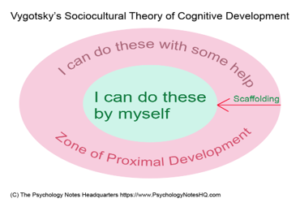
More Knowledgeable Other
According to Vygotsky’s theory of cognitive development, children learn through social interaction that includes collaborative and cooperative dialogue with someone who is more skilled in tasks they’re trying to learn. Vygotsky called these people with a higher skill level the More Knowledgeable Other (MKO). They could be teachers, parents, tutors, and even peers.
Scaffolding
Vygotsky’s concept of scaffolding is closely related to the concept of the Zone of Proximal Development. Scaffolding refers to the temporary support given to a child by a More Knowledgeable Other that enables the child to perform a task until such time that the child can perform this task independently.
SOCIAL LEARNING THEORY BY ALBERT BANDURA (1925)
He has done a great deal of work on social learning and is famous for his “Social Learning Theory” (renamed as “Social Cognitive Theory”). According to Bandura, development of competence depends on three kinds of factors:
- Behaviors children and adults observe within their home or society
- mental factors such as a student’s own expectations of success, and
- social factors such as classroom and school climate.
Each factor affects others equally and changes in one factor will result in changes in the others. In the classroom, for example, a child’s beliefs about himself and his competence (self-efficacy) can affect social behavior which, in turn, will have an impact on the classroom environment. At the same time, changes in the classroom that lead to a change in competence will have an impact on self-efficacy
ENVIRONMENTAL ECOLOGICAL THEORY BY URIE BRONFENBRENNER WAS BORN (1917-2005)
Ecological theory states that people develop within a series of environmental systems.
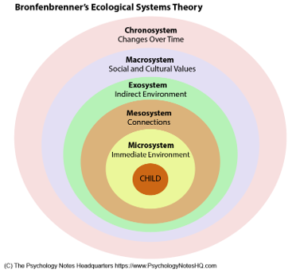
- At the base is Micro-system, which includes home, family, neighborhood, and school where the individual spends a large part of his time.
- The meso system functions as an interconnection between the micro system.
- Exo-system involves links between a social setting in which the individual does not have an active role and the individual’s immediate context. For example, a child’s experience at home may be influenced by the parents’ experiences at work.
- Macro-system describes the culture in which individuals. Cultural contexts include developing and industrialized countries, socioeconomic status, poverty, and ethnicity. Macro-system describes the culture in which individuals live.
- Chrono-system is the derivation of environmental events and changes in socio-historical conditions.
HOW PARENTS CAN SUPPORT SOCIAL DEVELOPMENT
Model positive behavior. Children learn from what they see.
Encourage social interaction through play and group activities.
Teach communication skills by talking and listening actively.
Guide behavior instead of punishing mistakes.
When to Be Concerned
Parents should seek help if:
- The child avoids social interaction completely
- Communication is significantly delayed
- Aggressive behavior is frequent
- The child struggles to form relationships
Early support improves outcomes.
TOP 10 PARENTING TIPS
- Encourage interaction with others
- Model respectful behavior
- Teach sharing and cooperation
- Support friendships
- Guide conflict resolution
- Limit negative influences
- Encourage communication
- Be emotionally available
- Observe social behavior
- Seek help when needed
Final Thought
Social development is not taught through rules.
It is learned through experience.
Every interaction a child has becomes a lesson.
And every relationship they build becomes part of who they are.
REFERENCES (APA 7)
- Bandura, A. (1977). Social learning theory. Prentice Hall.
- Bowlby, J. (1969). Attachment and loss. Basic Books.
- Erikson, E. H. (1968). Identity: Youth and crisis. Norton.
- Denham, S. A., et al. (2003). Preschool emotional competence and social behavior. Child Development.