
Erikson’s Stages of Psychosocial Development
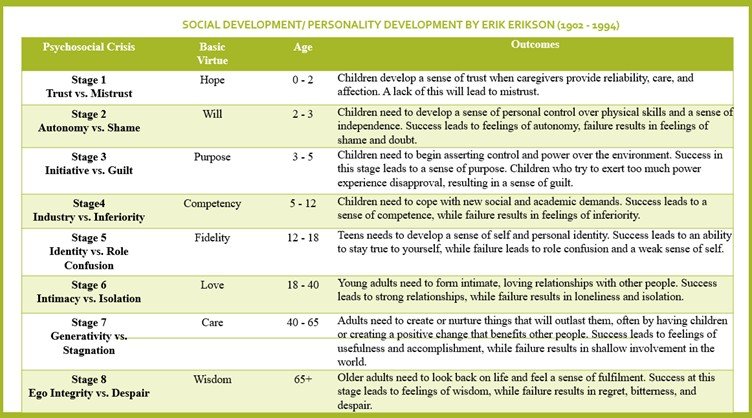
Erikson’s Stages of Psychosocial Development: A Complete Guide for Life
Human development is not only physical or cognitive—it is deeply social and emotional. Erik Erikson proposed that individuals pass through eight stages of psychosocial development, from infancy to adulthood. Each stage involves a psychological conflict that must be resolved to develop a healthy personality.
According to Erikson, successful resolution leads to psychological strengths, while unresolved conflicts may create challenges later in life (Erikson, 1950).
Stage 1: Trust vs Mistrust (Birth to 1 Year)
What Happens
Infants depend entirely on caregivers. When their needs are met consistently, they develop trust. If care is inconsistent or neglectful, mistrust may develop.
Key Characteristics
- Attachment to caregivers
- Response to comfort and care
- Development of basic trust
Parent Guide
Provide consistent care, affection, and responsiveness. Bonding and secure attachment are critical at this stage.
Activities
- Responsive feeding and caregiving
- Eye contact and smiling
- Talking and soothing interactions
When to Worry
- Lack of bonding or attachment
- Limited emotional response
- Avoidance of caregivers
Stage 2: Autonomy vs Shame and Doubt (1 to 3 Years)
What Happens
Children begin to develop independence. Success leads to autonomy, while excessive control or criticism leads to shame and doubt.
Key Characteristics
- Desire for independence
- Exploration and decision-making
- Development of self-control
Parent Guide
Allow safe independence. Avoid over-criticism. Encourage attempts rather than perfection.
Activities
- Self-feeding and dressing
- Simple choices (“Do you want this or that?”)
- Exploration-based play
When to Worry
- Extreme dependence
- Fear of trying new things
- Frequent frustration or withdrawal
Stage 3: Initiative vs Guilt (3 to 6 Years)
What Happens
Children begin to take initiative in activities and social interactions. Encouragement builds confidence, while discouragement may lead to guilt.
Key Characteristics
- Curiosity and imagination
- Leadership in play
- Asking questions
Parent Guide
Encourage creativity and initiative. Avoid dismissing ideas or over-controlling behavior.
Activities
- Pretend play
- Storytelling
- Creative arts
When to Worry
- Lack of initiative
- Fear of participation
- Excessive guilt or hesitation
Stage 4: Industry vs Inferiority (6 to 12 Years)
What Happens
Children develop competence through school and social activities. Success leads to a sense of industry, while failure leads to feelings of inferiority.
Key Characteristics
- Skill development
- Academic focus
- Peer comparison
Parent Guide
Encourage effort rather than results. Support learning and skill-building.
Activities
- Academic tasks
- Group projects
- Skill-based hobbies
When to Worry
- Low confidence
- Avoidance of challenges
- Academic or social difficulties
Stage 5: Identity vs Role Confusion (12 to 18 Years)
What Happens
Adolescents explore identity, values, and beliefs. Successful resolution leads to a strong sense of self.
Key Characteristics
- Identity exploration
- Emotional changes
- Influence of peers
Parent Guide
Support independence and open communication. Avoid forcing decisions.
Activities
- Goal setting
- Discussions about values
- Career exploration
When to Worry
- Confusion about identity
- Withdrawal or isolation
- Risky behavior
Stage 6: Intimacy vs Isolation (Young Adulthood)
What Happens
Individuals form close relationships. Success leads to intimacy, while failure results in isolation.
Key Characteristics
- Emotional connection
- Relationship building
- Commitment
Guidance
Encourage healthy relationships and emotional openness.
When to Worry
- Fear of relationships
- Emotional isolation
Stage 7: Generativity vs Stagnation (Adulthood)
What Happens
Adults focus on contributing to society and guiding the next generation.
Key Characteristics
- Productivity
- Parenting and mentorship
- Social contribution
Guidance
Encourage meaningful work and community involvement.
When to Worry
- Lack of purpose
- Disengagement from society
Stage 8: Integrity vs Despair (Late Adulthood)
What Happens
Individuals reflect on life. A sense of fulfillment leads to integrity, while regret leads to despair.
Key Characteristics
- Life reflection
- Acceptance
- Wisdom
Guidance
Encourage reflection, storytelling, and emotional support.
When to Worry
- Regret and dissatisfaction
- Depression or hopelessness
Why Erikson’s Theory Matters
Erikson’s theory connects emotional and social development across the entire lifespan. It helps parents and professionals understand how early experiences influence later behavior.
Modern research supports the importance of early relationships and social experiences in shaping long-term mental health (Shonkoff & Phillips, 2000).
Final Thoughts
Each stage of life brings new challenges and opportunities for growth. When individuals receive support at each stage, they develop confidence, identity, and emotional strength.
Understanding these stages allows parents, educators, and clinicians to guide development effectively and respond with awareness.
REFERENCES (APA 7)
- Erikson, E. H. (1950). Childhood and society. Norton.
- Erikson, E. H. (1968). Identity: Youth and crisis. Norton.
- Shonkoff, J. P., & Phillips, D. A. (2000). From neurons to neighborhoods. National Academy Press.